
A cloudy glass shower door is not always suffering from the same problem. What looks like soap scum may actually be a combination of soap residue, body oils, shower-product film, and hard-water minerals. That matters because a detergent that cuts oily residue may do little against mineral scale, while an aggressive abrasive can damage glass or a protective coating without solving the underlying problem.
The most effective approach is to identify the buildup first, match the cleaner to the deposit, use enough dwell time to loosen it, scrub gently, rinse thoroughly, and escalate only when necessary.
If the glass remains cloudy after appropriate cleaning, don't automatically scrub harder. Persistent discoloration can sometimes be mineral-related surface damage or glass etching rather than removable dirt.
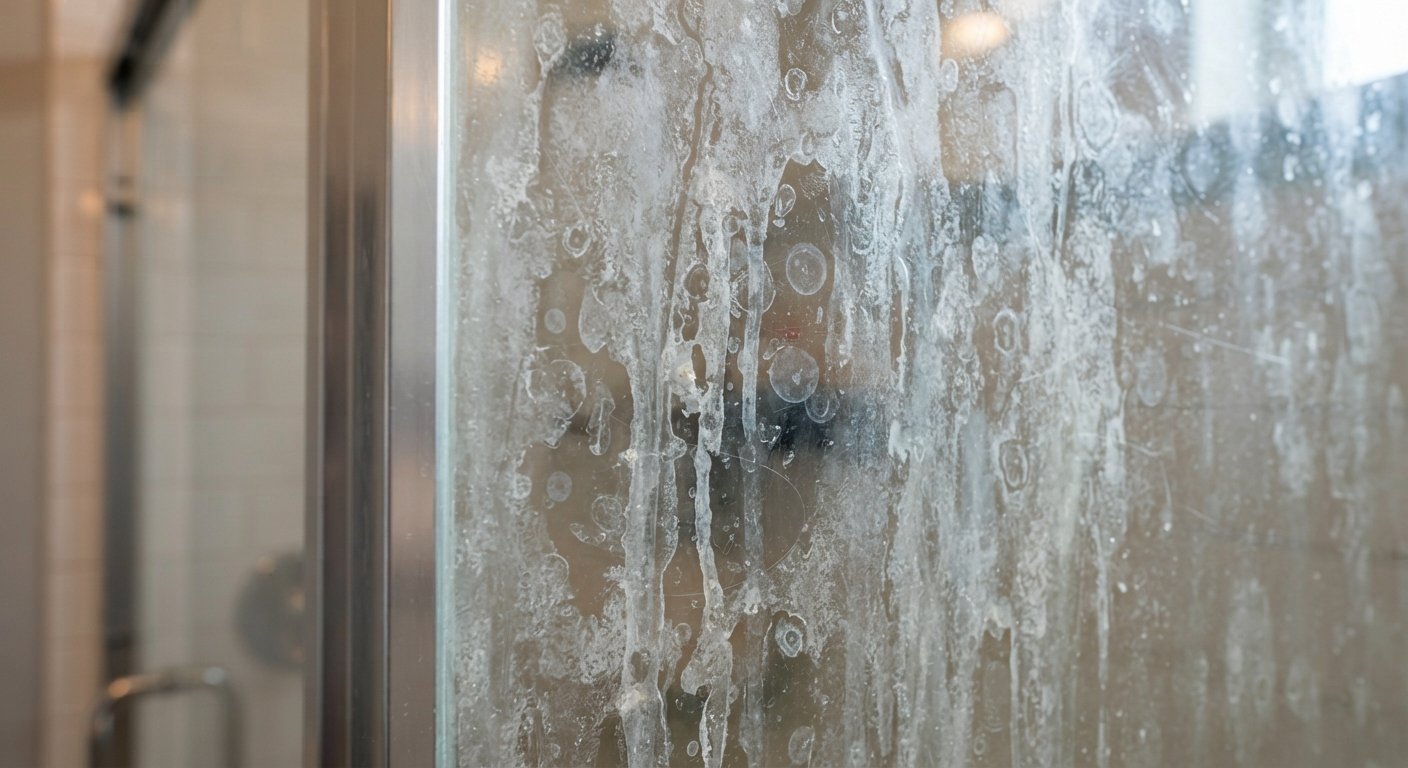
What Is the White Film on a Glass Shower Door?
The visible film on shower glass commonly falls into three categories: soap and oil residue, hard-water deposits, or a mixture of both.
Soap scum
Soap scum is associated with soap residue, body oils, and other shower products. Traditional soaps can react with minerals in water and leave an insoluble residue, while oils and product ingredients can contribute to a greasy or slippery film.
Fresh soap and product residue is usually easier to remove than an established film because it has not had as much time to dry, accumulate, and combine with mineral deposits.
A detergent-based cleaner is generally the logical starting point when the glass feels greasy, slippery, or coated with a product-like film.
Hard-water deposits
Hard-water deposits are different. Water containing dissolved minerals such as calcium and magnesium can leave deposits behind as water evaporates.
These deposits may appear as:
- White or chalky spots
- Cloudy patches
- Mineral rings
- Crusty deposits around frequently wet areas
- Numerous small water spots
Detergent alone may not remove established mineral scale effectively. An appropriate acidic descaling treatment, used according to the product directions and the glass manufacturer's care instructions, is generally more suitable for mineral deposits.
When soap scum and mineral deposits occur together
This is where shower-glass cleaning becomes confusing.
A door can have an oily soap film underneath or alongside a layer of mineral residue. Over time, the two can combine into a thick, cloudy coating that looks like one substance.
Use this as a practical guide rather than a definitive diagnosis:
| What you notice | Possible buildup | Starting approach |
|---|---|---|
| Greasy or slippery film | Soap/product residue and oils | Detergent-based cleaning |
| White, chalky spots | Mineral deposits | Appropriate acidic mineral treatment |
| Thick, cloudy film | Mixed soap and mineral buildup | Treat the residue and mineral component separately |
| Small persistent spots | Mineral deposits or possible surface damage | Try appropriate residue removal, then assess the glass |
The key principle is simple: identify the deposit before increasing cleaning strength.
What You Need to Clean Soap Scum From Glass
You do not need a large collection of specialized tools. Choose supplies according to the job.
For routine cleaning
- Microfiber cloths
- A non-abrasive sponge
- A soft-bristle brush for edges and hardware areas
- A shower squeegee
- A bucket or suitable spray bottle
- A mild detergent or appropriate shower-glass cleaner
- Clean water for rinsing
A microfiber cloth is useful for wiping and drying without relying on aggressive pressure. A non-abrasive sponge provides additional mechanical action when a simple wipe is insufficient.
A soft-bristle brush can help around corners, seals, and areas where residue collects, although the brush should still be appropriate for the surface being cleaned.
For stubborn buildup
When routine cleaning does not work, the next step should not automatically be a harsher abrasive.
Instead, determine whether the remaining material is primarily:
- Organic or soapy residue,
- Mineral scale,
- A combination of the two, or
- Potentially permanent surface damage.
For mineral deposits, an appropriate acidic cleaner may be more effective than repeatedly applying detergent. Commercial shower or glass cleaners can also be useful when their labels specifically indicate compatibility with the surface.
If your shower glass has a factory-applied protective coating or treatment, follow the manufacturer's cleaning instructions before using vinegar, citric acid, specialty descalers, or other chemical cleaners.
How to Clean Soap Scum Off Glass Shower Doors
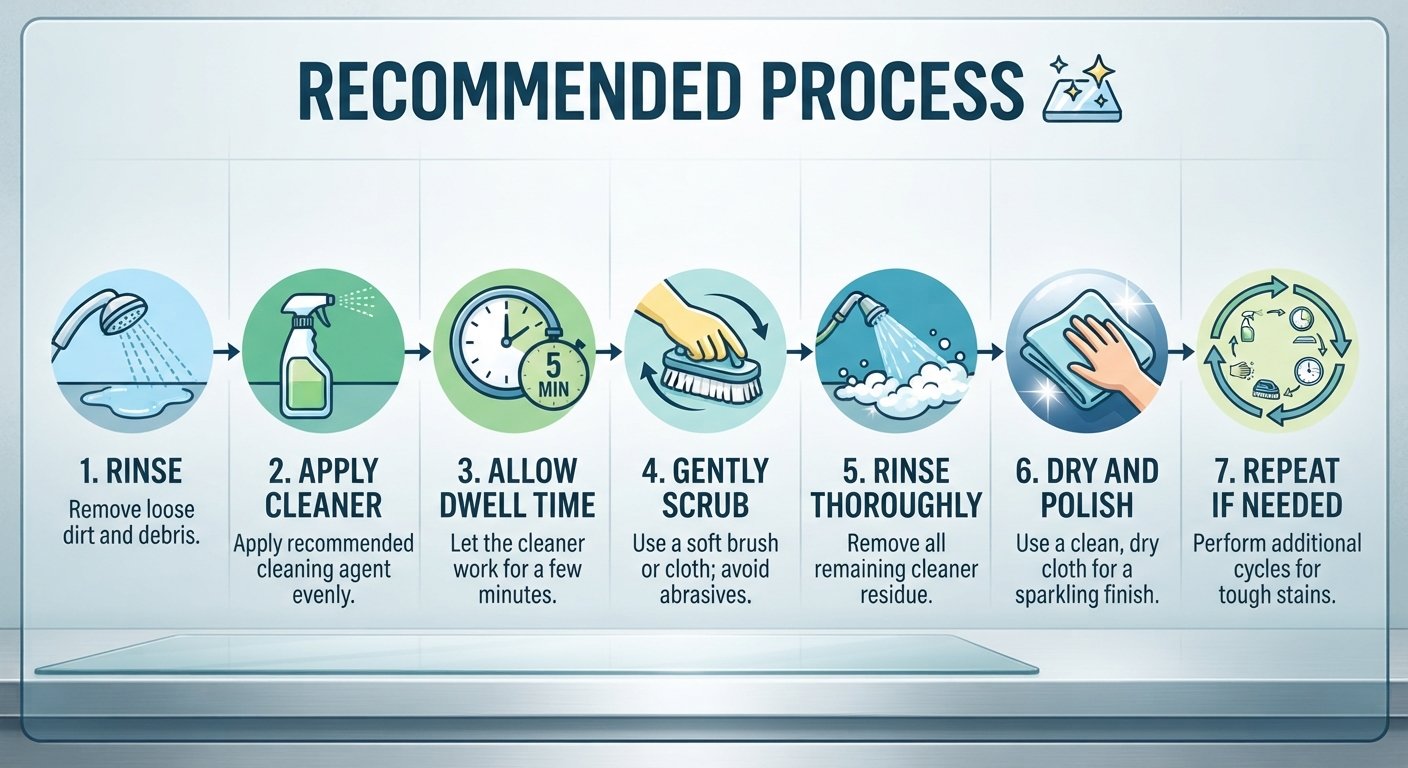
The following process works as a general cleaning system. Adjust the cleaner to the type of buildup and the manufacturer's instructions for your glass.
1. Rinse loose residue
Start by rinsing the shower door with water.
This removes loose dirt, hair, shampoo residue, and other material that could interfere with cleaning. It also means you are not immediately scrubbing loose particles across the glass.
For especially dirty doors, a preliminary rinse can make the subsequent cleaning considerably easier.
2. Apply the appropriate cleaner
Match the cleaner to the buildup.
For a greasy or soapy film, a mild detergent or suitable shower-glass cleaner is a reasonable starting point.
For obvious mineral deposits, use a cleaner designed to dissolve mineral buildup, provided it is compatible with the glass and any protective coating.
Do not assume that the strongest-smelling or most aggressive cleaner is the best choice. Cleaning effectiveness depends on whether the product can address the material you are trying to remove.
3. Let the cleaner dwell
One of the most overlooked parts of shower-glass cleaning is dwell time.
Dwell time is the period during which the cleaner remains on the surface before you wipe or scrub it away.
A cleaner that is immediately wiped off may not have enough time to loosen the deposit. Follow the product's stated contact time rather than allowing a chemical to remain on the glass indefinitely.
Keeping the surface appropriately wet during the recommended dwell period can help prevent the cleaner from drying before it has done its job.
4. Gently scrub the glass
Use a non-abrasive sponge, microfiber cloth, or other manufacturer-approved tool.
Work in controlled passes rather than attacking the glass with excessive force.
For stubborn areas, several moderate cleaning cycles are generally preferable to applying extreme pressure. More force does not necessarily mean more cleaning power, and unnecessary abrasion can create scratches or damage certain surface treatments.
Pay particular attention to the lower portion of the door and areas where water and shower products accumulate.
5. Rinse thoroughly
Rinse away both the cleaner and the loosened residue.
This step is important because leaving cleaning product or dissolved buildup on the glass can result in additional streaking or residue when the surface dries.
If necessary, rinse more than once until the water runs clean and there is no obvious cleaner remaining.
6. Dry and polish
Use a clean microfiber cloth to dry the glass.
Drying removes remaining water before it evaporates and leaves another layer of dissolved minerals behind.
For a large shower door, work systematically from one section to another rather than repeatedly wiping the same small area.
7. Repeat for stubborn buildup
If a substantial amount of residue remains, repeat the appropriate treatment.
A second cleaning cycle is often preferable to immediately switching to a highly abrasive method.
If the residue is not responding, reassess the diagnosis. You may be dealing with mineral scale rather than soap residue, or with a combination of deposits.
How to Remove Stubborn Soap Scum From Glass
Years of buildup require a different strategy from a lightly filmed shower door.
Start with mild cleaning
Begin with a detergent-based approach when the buildup appears greasy or soapy.
Give the cleaner appropriate dwell time, then gently agitate the surface and rinse.
Target the deposit
If the film remains but has a chalky or mineral appearance, the problem may not primarily be soap scum.
Switching repeatedly between different detergent products is unlikely to solve a mineral-scale problem. Instead, consider an appropriate mineral-deposit treatment that is compatible with the glass and any coating.
Repeat rather than over-scrub
Heavy deposits often require several treatment cycles.
A useful pattern is:
- Apply the appropriate cleaner.
- Allow the recommended dwell time.
- Gently agitate.
- Rinse completely.
- Dry the glass.
- Inspect the result.
- Repeat if necessary.
The objective is to remove the deposit progressively, not to force it off with increasingly aggressive physical pressure.
Consider a commercial product
If ordinary cleaning is ineffective, a commercial shower-glass or mineral-deposit cleaner may provide a more targeted formulation.
Read the label carefully and confirm that the product is suitable for your specific glass and any protective treatment.
Know when to stop
If appropriate cleaning repeatedly fails to change a cloudy area, continuing to scrub harder may not help.
The next question should be whether the glass itself has been altered.
How to Remove Hard-Water Stains From Glass Shower Doors
Hard-water stains are actually mineral deposits left behind when mineral-containing water evaporates.
Calcium and magnesium are common contributors. With repeated wetting and drying, mineral residue can accumulate into visible spots, cloudy patches, or scale.
Why detergent may not be enough
Detergents are useful for oily and soapy residues, but mineral deposits have different chemical properties.
That is why a shower door can look dirty even after it has been cleaned with a detergent-based product. The soap film may be gone while mineral deposits remain.
For suitable untreated glass, an appropriate acidic cleaner can help dissolve mineral deposits. Common household approaches include diluted white vinegar or citric-acid-based solutions, but compatibility with the particular glass and any coating should be confirmed first.
Commercial descaling products may also be appropriate when their instructions specifically allow use on shower glass.
Soap scum vs. hard-water stains
| Feature | Soap scum | Hard-water deposits |
|---|---|---|
| Typical appearance | Greasy, hazy, filmy | White, chalky, spotted or crusty |
| Main contributors | Soap, body oils, shower products | Dissolved minerals in water |
| Typical starting cleaner | Mild detergent | Appropriate mineral-deposit cleaner |
| Mechanical action | Gentle wiping or scrubbing | Gentle agitation after appropriate treatment |
| Why it returns | Product residue and moisture | Repeated water evaporation |
| Best prevention | Regular cleaning and rinsing | Squeegee and dry the glass |
In practice, many shower doors have both.
Can You Use Vinegar to Clean Glass Shower Doors?
Vinegar is commonly used as a household acidic cleaner and can help with certain mineral deposits.
That does not make vinegar a universal shower-door cleaner.
Vinegar may be less effective against a thick layer of oily soap residue, where detergent-based cleaning may be more appropriate. It also may not solve permanent glass etching or other surface damage.
Surface compatibility matters
If the shower glass has a factory-applied coating, water-repellent treatment, protective finish, or other surface treatment, check the manufacturer's care instructions before applying vinegar or another acidic cleaner.
When using any cleaning product:
- Follow the label directions.
- Use appropriate ventilation.
- Wear gloves if recommended.
- Keep the cleaner away from incompatible surfaces.
- Never mix cleaning chemicals indiscriminately.
- Never combine products simply because each one is effective on its own.
A cleaner should be selected based on the deposit and the surface—not simply because it is a popular household remedy.
What Not to Use on Glass Shower Doors
The goal is to remove the deposit without damaging the glass or its finish.
Abrasive powders
Abrasive powders can introduce unnecessary physical abrasion.
Potential problem: Scratching or dulling of the surface.
Safer approach: Start with a suitable liquid cleaner and a non-abrasive cleaning tool.
Rough scouring pads
Some aggressive pads are designed for surfaces that can tolerate substantial abrasion.
Potential problem: Scratches or damage to surface treatments.
Safer approach: Use a non-abrasive sponge, microfiber cloth, or tool specifically approved for shower glass.
Metal scrubbers
Steel wool and other metal scouring materials are unnecessarily aggressive for routine glass cleaning.
Potential problem: Scratches and damage to finishes or adjacent surfaces.
Safer approach: Use controlled chemical cleaning combined with gentle mechanical agitation.
Sharp scraping tools
A razor or other scraper should not be treated as a universal solution.
Potential problem: Incorrect technique, an unsuitable blade, or debris trapped between the blade and surface can damage the glass or its treatment.
Safer approach: Follow the glass manufacturer's instructions. If a scraper is specifically permitted, use the correct tool and technique rather than improvising.
Excessive force
If a deposit will not come off, pushing harder is not necessarily the answer.
Potential problem: Scratches, damaged coatings, or injury from slipping tools.
Safer approach: Reassess the type of buildup and use an appropriate treatment cycle.
Incompatible chemical mixtures
Never mix cleaning chemicals indiscriminately.
Potential problem: Some combinations can produce hazardous fumes or unwanted chemical reactions.
Safer approach: Use one compatible cleaning system at a time, follow the product label, and rinse the surface thoroughly before changing to a different type of cleaner.
How to Tell If the Glass Is Still Dirty or Permanently Etched
This is one of the most important distinctions in shower-glass care.
Removable residue sits on the surface. Etching changes the surface itself.
A glass door may remain cloudy even after repeated cleaning because the visible defect is no longer simply a layer of dirt.
Mineral deposits can also become difficult to distinguish from surface damage after prolonged exposure.
A practical approach is to clean a small test area using an appropriate method. If the treated area becomes visibly clearer while the untreated area remains cloudy, removable residue is likely contributing to the appearance.
If appropriate cleaning has repeatedly failed to improve a cloudy area, however, continuing to increase pressure or abrasiveness is not a good troubleshooting strategy.
Persistent areas may involve:
- Mineral deposits that require a different treatment.
- Surface staining.
- Glass etching.
- Damage to a protective coating.
- Permanent changes to the glass surface.
At that point, consider consulting a glass professional or the shower-door manufacturer rather than repeatedly applying stronger chemicals or abrasives.
How to Prevent Soap Scum From Building Up Again
The easiest shower door to clean is the one that never develops a thick layer of buildup.
Prevention is mainly about removing water and residue before they have repeated opportunities to dry onto the glass.
After every shower
Use a shower squeegee to remove water from the glass.
It takes much less effort to remove a thin layer of water immediately than to remove mineral deposits after dozens of evaporation cycles.
If practical, follow the squeegee with a microfiber cloth on areas where water tends to remain.
Clean before buildup becomes thick
Do not wait until the door becomes visibly cloudy.
Regular light cleaning prevents small amounts of residue from accumulating into a difficult combination of soap film and mineral scale.
The ideal frequency depends on:
- How often the shower is used.
- How hard the household's water is.
- How much water remains on the glass.
- How much shower-product residue is produced.
- How well the bathroom ventilates.
Improve ventilation
Ventilation helps reduce persistent moisture in the bathroom.
Use the bathroom exhaust fan when appropriate and allow the room to dry after showering.
Reducing prolonged moisture does not eliminate soap scum or mineral deposits by itself, but it can support a broader maintenance routine.
Pay attention to product residue
Shampoo, conditioner, body wash, soap, shaving products, and other shower products can contribute to residue.
You do not necessarily need to eliminate a particular product. The practical objective is to prevent excess product from remaining on the glass and to rinse and dry the surface regularly.
How Often Should You Clean Glass Shower Doors?
There is no single cleaning schedule that fits every shower.
Instead, base the frequency on the rate at which buildup develops.
A practical maintenance schedule looks like this:
- After each shower: Squeegee water from the glass.
- Regularly: Perform routine surface cleaning before visible buildup becomes heavy.
- As needed: Perform a deeper treatment when film, spots, or cloudiness become noticeable.
- More frequently: Increase cleaning frequency in households with heavy shower use or significant hard-water deposits.
If a shower door becomes cloudy within a few days, weekly cleaning may not be enough to prevent buildup. If the glass remains clear with minimal maintenance, there may be little reason to increase the frequency simply because another schedule recommends it.
The right schedule is the one that keeps deposits from becoming established.
Common Mistakes When Cleaning Shower Glass
Waiting until buildup becomes thick
Established deposits take more work to remove.
Better approach: Perform smaller maintenance cleanings before residue accumulates.
Treating mineral scale like ordinary soap residue
A detergent can remove oily film while leaving mineral deposits behind.
Better approach: Identify whether the remaining material is mineral-based and select the appropriate treatment.
Using excessive abrasive force
More pressure can make a difficult cleaning job worse.
Better approach: Allow the cleaner to do more of the work through appropriate application and dwell time.
Leaving chemicals on the glass longer than directed
Longer is not automatically better.
Better approach: Follow the product's specified contact time.
Failing to rinse
Cleaner and loosened residue can remain on the surface and contribute to streaking or additional residue.
Better approach: Rinse thoroughly before drying.
Mixing incompatible chemicals
Combining cleaning products can create dangerous reactions.
Better approach: Never mix cleaners unless the manufacturer specifically indicates that combination is safe.
Ignoring manufacturer guidance
Treated or coated glass may have specific cleaning requirements.
Better approach: Check the manufacturer's instructions before using acids, abrasives, specialty cleaners, or scraping tools.
Cleaning only the glass
The door tracks, frames, seals, and surrounding surfaces can also collect soap, dirt, and mineral residue.
Better approach: Include the surrounding shower-door components in your regular cleaning routine, using materials appropriate for each surface.
Frequently Asked Questions
How do you get thick soap scum off glass shower doors?
First determine whether the thick buildup is actually soap scum, mineral scale, or both. Start with a suitable detergent-based cleaner for greasy or soapy residue. If a chalky or cloudy mineral layer remains, use an appropriate mineral-deposit treatment that is compatible with the glass. Allow the recommended dwell time, gently agitate, rinse, dry, and repeat rather than relying on excessive scrubbing.
What removes soap scum from glass best?
For primarily oily or soapy residue, a suitable detergent-based cleaner is generally the logical starting point. The best method depends on the composition of the buildup. If minerals are involved, detergent alone may leave the glass cloudy.
How do you remove cloudy film from shower glass?
Determine whether the cloudiness is removable residue or a change to the glass surface. Try an appropriate cleaning method on a small area first. If the cloudiness responds, continue with the appropriate treatment. If repeated, compatible cleaning does not improve it, the glass may have mineral-related surface damage or etching and may require professional assessment.
Does vinegar remove soap scum from shower doors?
Vinegar can help dissolve certain mineral deposits, but it is not equally effective against every type of soap or oil residue. If the shower glass is coated or treated, verify compatibility with the manufacturer before using vinegar or another acidic cleaner.
How do you remove hard-water stains from glass shower doors?
Use a cleaner designed to dissolve mineral deposits and compatible with the glass. Acidic cleaners can be effective against suitable mineral buildup. Apply according to the product instructions, allow the recommended dwell time, gently agitate, rinse thoroughly, and dry the glass.
Can baking soda scratch glass?
Baking soda is mildly abrasive, so using it with aggressive scrubbing can introduce unnecessary abrasion. Whether a particular application damages a particular glass surface depends on the material, pressure, particles present, and surface treatment. For routine shower-glass cleaning, a non-abrasive approach is the safer default.
Why does my shower glass get cloudy again so quickly?
Rapid clouding can result from frequent shower use, hard water, standing water, shower-product residue, or insufficient drying. If the glass repeatedly becomes cloudy despite appropriate cleaning, investigate whether mineral deposits or permanent surface damage are contributing.
How do you prevent soap scum on glass shower doors?
Squeegee the glass after each shower, remove standing water, clean the surface regularly, and maintain good bathroom ventilation. Preventing residue from repeatedly drying on the glass is easier than removing an established layer later.
How can you tell whether shower glass is stained or etched?
Clean an inconspicuous area using an appropriate, surface-compatible method. If the cloudy appearance improves, removable residue was likely contributing. If an area remains unchanged after appropriate cleaning, the problem may involve etching, surface damage, or another permanent alteration rather than ordinary dirt.
Can you use a razor blade on a glass shower door?
Do not assume that a razor is safe for every shower door. Some glass-care instructions may permit specific scraping techniques, while coated or treated surfaces can have additional restrictions. Follow the manufacturer's instructions before using any blade. If scraping is permitted, the correct tool, angle, lubrication, and technique matter.
How often should shower glass be cleaned?
Squeegee the glass after each shower and perform routine cleaning often enough to prevent visible buildup from becoming established. Deep cleaning frequency depends on shower use, water hardness, ventilation, and how quickly residue accumulates.
The Simple Shower-Glass Decision System
When a shower door looks dirty, don't start by asking, “What is the strongest cleaner I can use?”
Start by asking, “What is actually on the glass?”
The goal is not simply to make the shower door look clean today. It is to match the treatment to the deposit, protect the glass while cleaning it, and prevent the same buildup from becoming a recurring problem.
Need Help With Cleaning?
For more information about cleaning services, visit Deep Clean Chicago.
Visit Deep Clean Chicago