
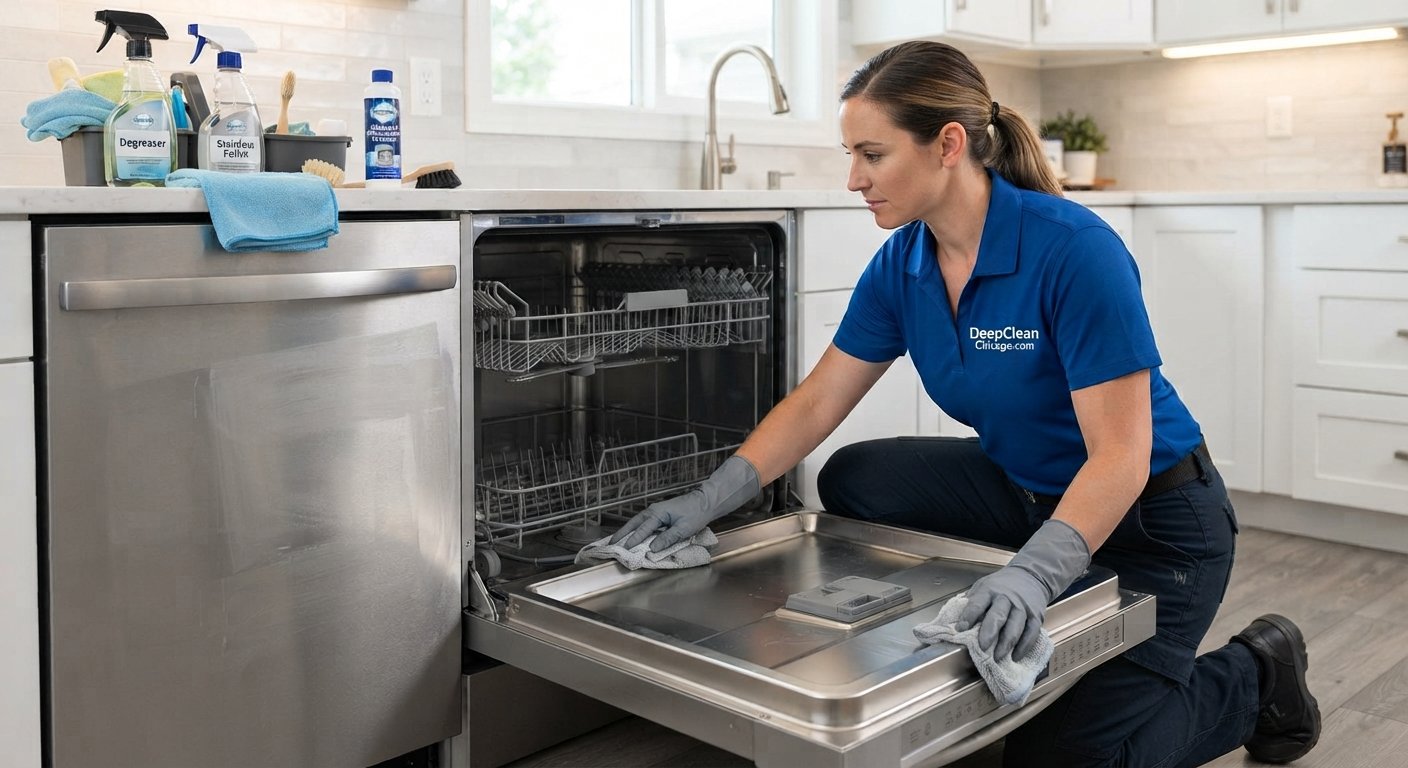
A dishwasher needs more than an occasional empty cleaning cycle to stay clean and perform properly. Food particles can collect in the filter and drain area, mineral deposits can block spray-arm openings, and grease or residue can build up on the gasket, racks, detergent dispenser, and tub.
To clean a dishwasher, empty it, remove visible food debris, clean the filter, inspect the spray arms, wipe the door gasket, clean the racks and tub, check the accessible drain area and detergent dispenser, and run a manufacturer-approved cleaning cycle when appropriate.
The exact procedure varies by dishwasher manufacturer and model. Always check your owner's manual before removing components or using vinegar, baking soda, acidic cleaners, abrasive products, or other cleaning chemicals.
Quick Answer: How Do You Clean a Dishwasher?
For most dishwashers, the basic process is:
- Empty the dishwasher.
- Remove visible food debris.
- Clean the filter according to the owner's manual.
- Inspect and clean the spray arms.
- Clean the racks and rack supports.
- Wipe the door gasket and edges.
- Clean the tub and interior surfaces.
- Inspect the accessible drain area.
- Clean the detergent dispenser.
- Run an approved cleaning or maintenance cycle if appropriate.
- Wipe the exterior and control panel.
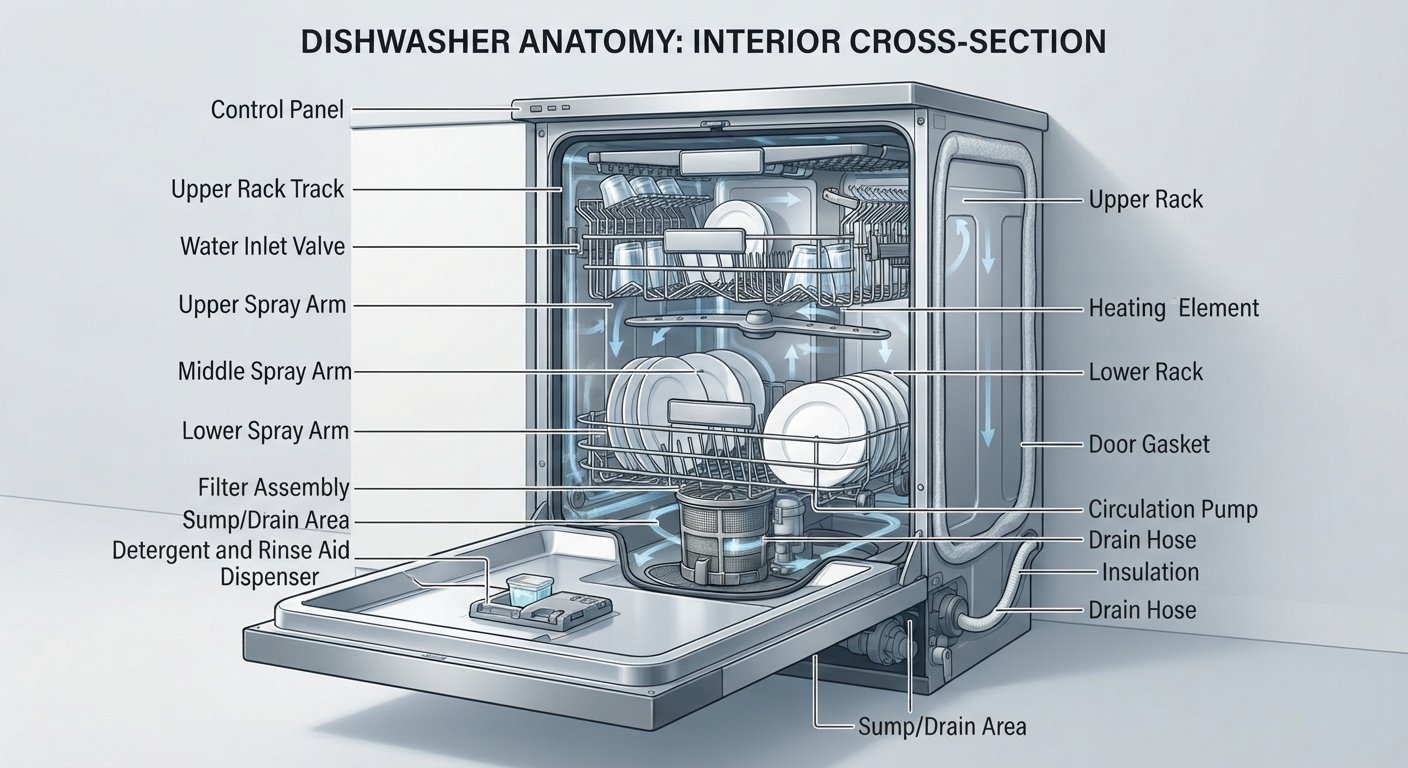
A dishwasher washes dishes, circulates water, distributes detergent, filters food particles, drains wastewater, and may use heat during cleaning or drying. Because different components perform different jobs, effective dishwasher cleaning means addressing the components themselves rather than relying only on a cleaning product or empty cycle.
What Parts of a Dishwasher Need Cleaning?
The main dishwasher components involved in routine cleaning and maintenance include:
| Component | Main function | Common buildup |
|---|---|---|
| Filter | Catches food particles and debris | Food, grease, residue |
| Lower spray arm | Distributes wash water | Food particles, mineral deposits |
| Upper spray arm | Distributes water to upper areas | Food particles, mineral deposits |
| Door gasket | Helps seal the wash chamber | Food residue, moisture, grime |
| Tub | Holds wash water and dishes | Grease, residue, mineral deposits |
| Drain area | Helps wastewater leave the appliance | Food debris, residue |
| Racks | Hold dishes in position | Food particles, residue, minerals |
| Detergent dispenser | Releases dishwasher detergent | Detergent residue, buildup |
| Door and exterior | Provide access and visible surfaces | Grease, fingerprints, spills |
These components are connected through the dishwasher's normal operation:
- Food debris → filter or drain area → restricted filtration or drainage
- Food or mineral buildup → blocked spray-arm opening → reduced water distribution
- Residue or moisture → gasket, tub, or other buildup-prone areas → unpleasant odors
- Detergent residue → dispenser buildup → possible obstruction of detergent release
Cleaning each relevant component addresses a different part of the dishwasher's operation.
What You Need to Clean a Dishwasher
For routine cleaning, gather:
- Microfiber cloths
- Soft sponge
- Warm water
- Soft brush or old toothbrush
- Manufacturer-approved dishwasher cleaner, when appropriate
- Towel or shallow container for catching water around removable components
- Vinegar or baking soda only if compatible with the manufacturer's instructions
Can You Use Regular Dish Soap?
Ordinary liquid dish soap designed for hand washing dishes should not be used inside an automatic dishwasher unless the manufacturer specifically instructs you to do so.
Hand dishwashing liquid can produce excessive suds and may cause operational or cleanup problems.
Use dishwasher detergent and cleaning products intended for automatic dishwashers, following the manufacturer's instructions.
What About Acidic or Abrasive Cleaners?
Do not assume that a household cleaner is safe simply because it works on another surface.
Before using an acidic cleaner, abrasive cleaner, descaler, concentrated chemical, or other cleaning product:
- Check the owner's manual.
- Confirm that the product is compatible with your dishwasher.
- Follow the product instructions.
- Use the recommended amount and frequency.
- Never mix cleaning chemicals unless the manufacturer explicitly directs you to do so.
How to Clean a Dishwasher Step by Step
1. Empty the Dishwasher
Remove all dishes, utensils, and other items.
If necessary, remove the racks according to the manufacturer's instructions so you can access the bottom of the tub, filter, and spray-arm area.
Look for visible:
- Food particles
- Grease
- Labels
- Broken pieces
- Loose debris
- Residue
- Standing water
Remove large pieces of food and other loose debris before cleaning the individual components.
You generally do not need to fully rinse dishes before loading them, but large food particles should be scraped or removed according to your dishwasher manufacturer's loading recommendations.
2. Clean the Dishwasher Filter
The filter is one of the most important dishwasher components to maintain because it catches food particles and other debris during the wash process.
Where Is the Dishwasher Filter?
On many dishwashers, the filter is located near the bottom of the tub, around or beneath the lower spray arm.
Filter designs vary by manufacturer and model. Some filters are removable and designed for routine user cleaning, while other filtration systems use different arrangements.
Never force a filter that does not release easily. Check your owner's manual for the correct removal procedure.
How to Clean the Dishwasher Filter
- Remove the filter according to the manufacturer's instructions.
- Rinse it under warm running water.
- Use a soft brush to loosen trapped food and residue.
- Pay particular attention to mesh and fine-screen areas.
- Clean the accessible area around the filter.
- Inspect the filter for damage or persistent buildup.
- Reinstall it exactly as directed.
Correct reinstallation matters because the filter must sit securely in its intended position for the filtration system to operate correctly.
How Often Should You Clean the Dishwasher Filter?
Follow your manufacturer's recommended maintenance schedule and inspect the filter regularly.
You may need to clean it more frequently if you notice:
- Food debris accumulating quickly
- Grit on dishes
- Bad odors
- Visible residue
- Reduced cleaning performance
A heavily used dishwasher may require more frequent filter cleaning than a lightly used appliance.
3. Clean the Dishwasher Spray Arms
Spray arms distribute water throughout the dishwasher. Depending on the model, there may be a lower spray arm, an upper spray arm, or additional water-distribution components.
The spray arms need to move and distribute water freely. Their small openings can become blocked by food particles, grease, mineral deposits, or hard-water buildup.
How to Clean Dishwasher Spray Arms
- Inspect the upper and lower spray arms.
- Check the openings for visible blockage.
- Confirm that the arms can move as intended.
- Remove a spray arm only if the manufacturer allows it.
- Rinse it with warm water.
- Use a soft brush to remove accessible buildup.
- Check that the openings are clear.
- Reinstall the spray arm correctly.
Avoid aggressively scraping or enlarging the spray openings. They are designed to deliver water in a particular pattern, and damaging them can affect water distribution.
4. Clean the Dishwasher Racks and Rack Supports
Dishwasher racks hold dishes in position so water can circulate around them.
Racks can collect food residue, grease, detergent residue, and mineral buildup, particularly around corners, tines, wheels, and supports.
Inspect and clean:
- Rack surfaces
- Tines
- Corners
- Wheels or rollers
- Rack supports
- Areas where residue becomes trapped
Use warm water and a soft cloth or sponge unless your manufacturer's instructions specify another method.
If the rack coating is damaged or rust is developing, consult the manufacturer for appropriate maintenance or replacement guidance.
5. Clean the Door Gasket and Edges
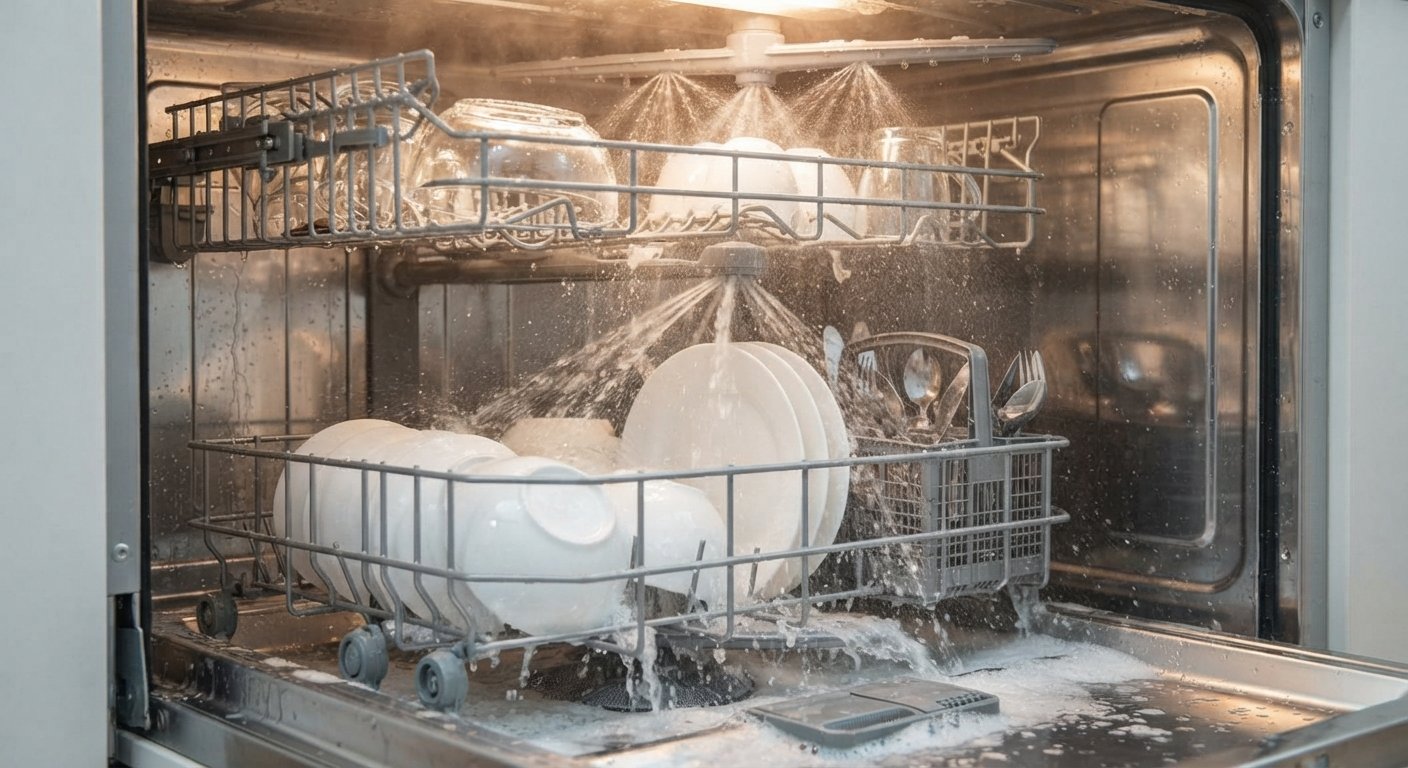
The door gasket is the rubber seal around the dishwasher door. It helps seal the wash chamber when the door closes.
The gasket and surrounding door perimeter can collect:
- Food residue
- Grease
- Moisture
- Dirt
- Detergent residue
These materials can contribute to visible buildup and unpleasant odors.
How to Clean the Dishwasher Gasket
Wipe the gasket with a damp microfiber cloth or soft sponge.
Clean the entire door perimeter, paying particular attention to folds, corners, and areas that are difficult to see.
Wipe the surrounding door edges as well.
Avoid stretching, cutting, or aggressively scrubbing the rubber seal.
6. Clean the Dishwasher Tub and Interior
The tub is the main interior chamber where washing takes place. It can accumulate grease, food residue, mineral deposits, detergent residue, and other buildup.
Clean accessible surfaces including:
- Bottom of the tub
- Side walls
- Back wall
- Corners
- Interior of the door
- Areas around the filter
- Rack-support areas
Use warm water and an appropriate soft cloth or sponge.
If you notice white film or deposits, do not automatically assume they are food residue. Mineral deposits, hard-water buildup, and detergent residue can also leave a white coating.
Identify the type of buildup before choosing a cleaning or descaling method, and follow the manufacturer's guidance.
7. Check the Dishwasher Drain Area
The drain area works with the filtration and drainage system to help remove wastewater.
Inspect the accessible area around the filter and drain for visible food particles or residue.
Food debris → filter or drain area → restricted flow → poor drainage or standing water
Remove accessible debris according to the manufacturer's instructions.
Do not dismantle pumps, hoses, plumbing, or internal drainage components as part of routine cleaning unless the manufacturer specifically provides instructions for doing so.
If significant water repeatedly remains in the bottom of the dishwasher after a cycle, the issue may require drainage troubleshooting rather than additional cleaning products.
8. Clean the Detergent Dispenser
The detergent dispenser releases dishwasher detergent during the wash cycle.
Inspect it for:
- Hardened detergent
- Residue
- Grease
- Debris
- Obstructions around the dispenser door
Wipe accessible surfaces with a damp cloth and follow the manufacturer's cleaning instructions.
The dispenser should be able to open and release detergent as designed.
Do not fill the dispenser with household cleaning chemicals unless the manufacturer specifically instructs you to do so.
9. Run a Dishwasher Cleaning Cycle
After manually cleaning the major components, you may be able to run an empty maintenance or cleaning cycle.
If your dishwasher has a dedicated cleaning cycle, follow the manufacturer's instructions.
A dishwasher cleaner may be appropriate when recommended for your model.
An empty cleaning cycle can help address certain types of interior residue, but it does not replace manual cleaning of the filter, spray arms, gasket, racks, detergent dispenser, or accessible drain area.
Think of the cleaning cycle as one part of dishwasher maintenance, not the entire cleaning process.
10. Clean the Exterior and Control Panel
Finish by wiping the dishwasher exterior and control panel.
Use a microfiber cloth and a cleaner compatible with the exterior material.
Avoid allowing excessive liquid to enter controls, buttons, displays, seams, or electrical areas.
Follow the manufacturer's care instructions for stainless steel, painted finishes, plastic, or other exterior materials.
Can You Clean a Dishwasher With Vinegar?
Vinegar is sometimes used for household cleaning and may help with certain types of mineral buildup, but it should not automatically be treated as a universal dishwasher cleaner.
Dishwasher manufacturers can differ in their recommendations because materials, seals, finishes, and internal components vary between models.
Before using vinegar:
- Check the owner's manual.
- Confirm whether vinegar is compatible with your model.
- Follow any manufacturer-specified procedure.
- Use the recommended quantity if one is provided.
- Do not assume that repeated vinegar use is appropriate simply because it is commonly recommended online.
If your manufacturer recommends a dedicated dishwasher cleaner instead, follow that recommendation.
Can You Use Baking Soda in a Dishwasher?
Baking soda is another commonly suggested household cleaning ingredient. It may be suitable for some cleaning approaches, but it should be treated as a conditional method rather than a universal dishwasher treatment.
Before using baking soda:
- Check the owner's manual.
- Confirm product compatibility.
- Follow the manufacturer's maintenance instructions.
- Do not substitute it for a manufacturer-recommended cleaner without checking compatibility.
How Often Should You Clean a Dishwasher?
There is no single cleaning schedule that applies equally to every dishwasher.
Frequency depends on:
- Manufacturer recommendations
- Frequency of use
- Amount of food debris
- Loading habits
- Detergent
- Water conditions
- Visible buildup
- Odors
- Cleaning performance
A practical maintenance routine is:
| Component | When to inspect or clean |
|---|---|
| Filter | According to manufacturer guidance and whenever significant debris accumulates |
| Spray arms | Periodically and whenever openings become blocked |
| Gasket | When food residue, moisture, or grime accumulates |
| Tub | When residue, grease, mineral buildup, or odors become noticeable |
| Drain area | When debris or drainage symptoms appear |
| Detergent dispenser | When residue or buildup becomes visible |
| Racks | When residue or mineral buildup accumulates |
| Cleaning cycle | According to manufacturer recommendations |
| Exterior | As needed |
Rather than following an arbitrary universal schedule, use:
Manufacturer guidance + actual appliance condition = appropriate maintenance frequency
How to Remove Dishwasher Odors
A bad dishwasher smell can result from food debris, grease, residue, or moisture accumulating inside the appliance.
Start by inspecting the areas most likely to collect buildup:
- Filter
- Drain area
- Bottom of the tub
- Door gasket
- Door edges
- Spray arms
- Detergent dispenser
Clean the affected components and run an appropriate maintenance cycle if your manufacturer recommends one.
If the odor returns quickly despite thorough cleaning, investigate whether there is a drainage, plumbing, moisture, or appliance problem rather than repeatedly adding cleaning products.
What If the Dishwasher Still Does Not Clean Properly?
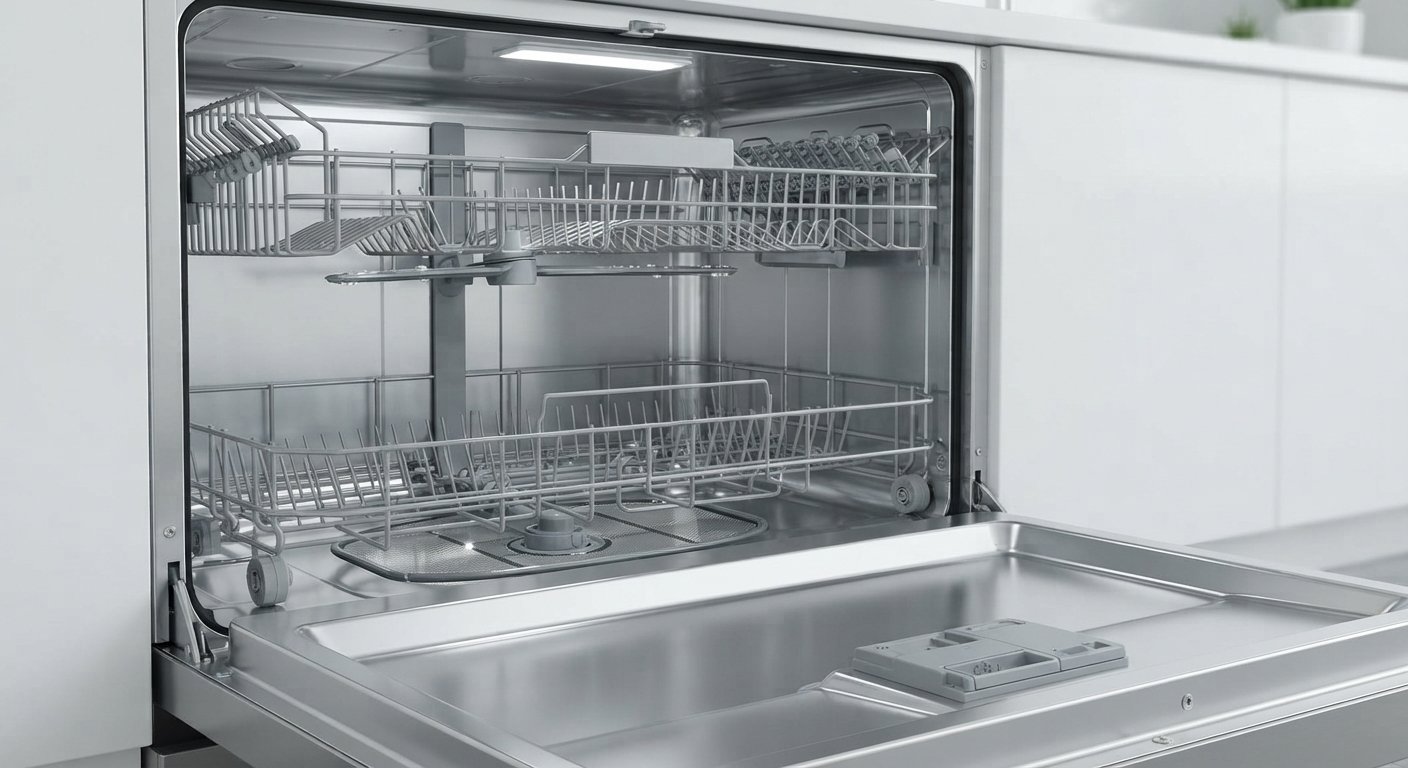
If dishes remain dirty after cleaning the dishwasher, use the symptom to determine which component or operating area to check first.
| Symptom | What to check | What to do |
|---|---|---|
| Bad odor | Filter, tub, drain area, gasket, dispenser | Remove debris and residue; inspect for trapped moisture |
| Dirty dishes | Filter, spray arms, loading, detergent | Clean the filter, clear spray openings, and review loading and detergent instructions |
| Gritty dishes | Filter, tub, accumulated residue | Clean the filter and remove visible residue |
| White film | Mineral deposits, hard-water buildup, detergent residue | Identify the buildup and use a manufacturer-approved cleaning method |
| Poor water distribution | Spray-arm openings and rotation | Clear accessible blockages and verify normal spray-arm movement |
| Persistent standing water | Filter, drain area, drainage system | Clean accessible areas and consult troubleshooting guidance if water remains |
| Door-area residue | Gasket and door edges | Clean the seal and surrounding surfaces |
| Detergent remains | Dispenser and wash conditions | Clean the dispenser and check detergent/loading guidance |
These are troubleshooting starting points, not definitive diagnoses.
For example, dirty dishes can result from blocked spray openings, a dirty filter, incorrect loading, detergent-related issues, insufficient water circulation, or an appliance problem.
Persistent standing water can involve the accessible filter or drain area, but it can also indicate a problem with internal drainage components.
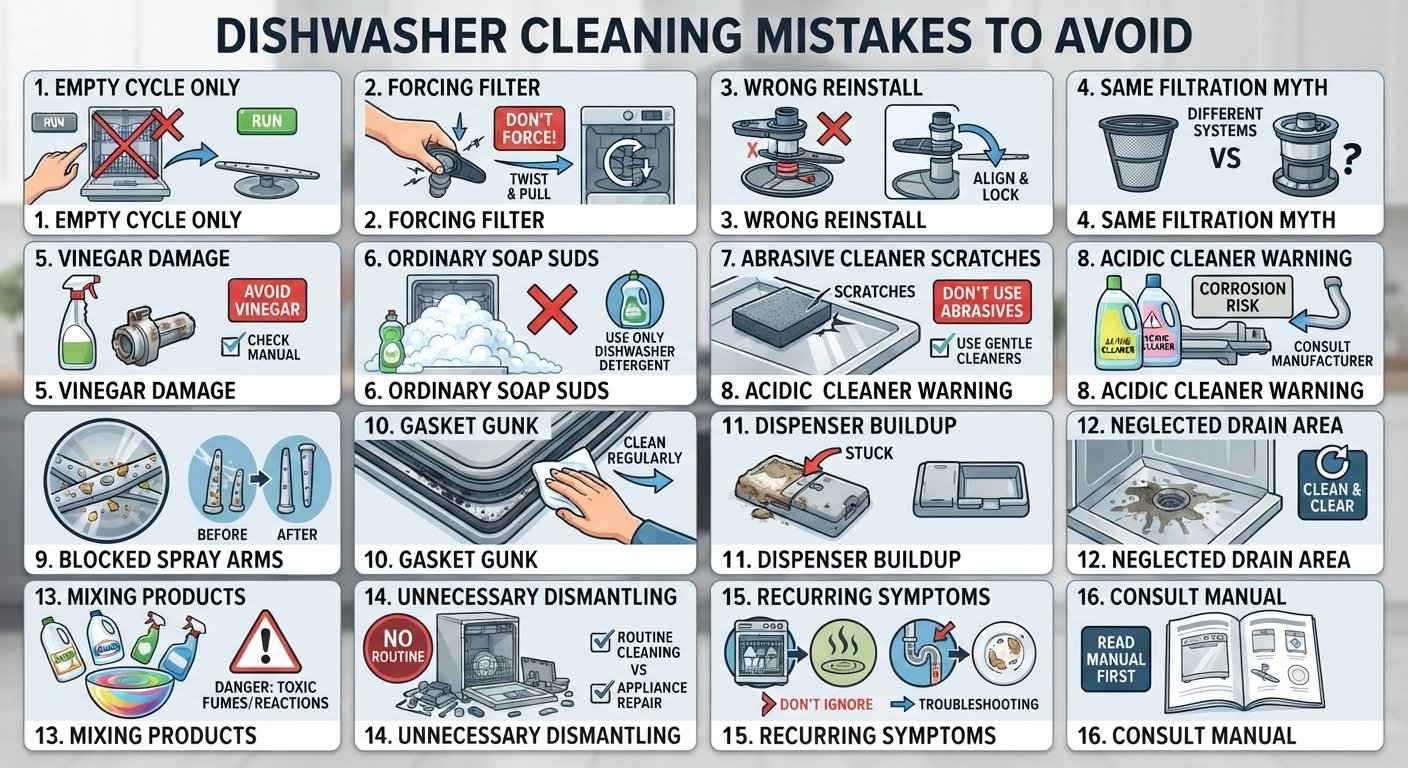
Dishwasher Cleaning Mistakes to Avoid
Avoid these common mistakes:
- Only running an empty cleaning cycle. A cleaning cycle does not automatically clean every component.
- Forcing the filter. Filter designs and removal mechanisms vary.
- Reinstalling the filter incorrectly. Follow the manufacturer's instructions.
- Assuming every dishwasher has the same filtration system.
- Treating vinegar as universally safe. Check the manufacturer's guidance.
- Using ordinary dish soap inside the dishwasher. It can create excessive suds.
- Using abrasive cleaners without checking compatibility. They may damage surfaces or components.
- Using acidic cleaners without manufacturer guidance.
- Ignoring blocked spray-arm openings. Restricted openings can reduce water distribution.
- Neglecting the gasket. The seal can collect residue and moisture.
- Ignoring the detergent dispenser. Buildup may interfere with detergent release.
- Neglecting the accessible drain area.
- Mixing cleaning products.
- Dismantling internal components unnecessarily. Routine cleaning and appliance repair are different tasks.
- Ignoring recurring symptoms. Persistent odors, leaks, drainage problems, or poor cleaning may require troubleshooting beyond routine maintenance.
Dishwasher Cleaning Tips for Chicago Homes
For Chicago households, dishwasher maintenance should be based on the actual appliance and conditions in the home rather than assumptions about every local household.
Dishwashers in apartments, condos, older homes, and newer kitchens can differ in:
- Manufacturer
- Model
- Age
- Filtration design
- Plumbing configuration
- Usage
- Detergent
- Water conditions
If you notice white mineral buildup, recurring residue, or persistent odors, identify the condition you can observe and follow the dishwasher manufacturer's recommended cleaning method.
Avoid universal claims such as:
“Every Chicago dishwasher has hard-water problems and needs vinegar.”
If routine cleaning does not resolve persistent drainage, washing, odor, or leakage problems, qualified appliance service may be appropriate.
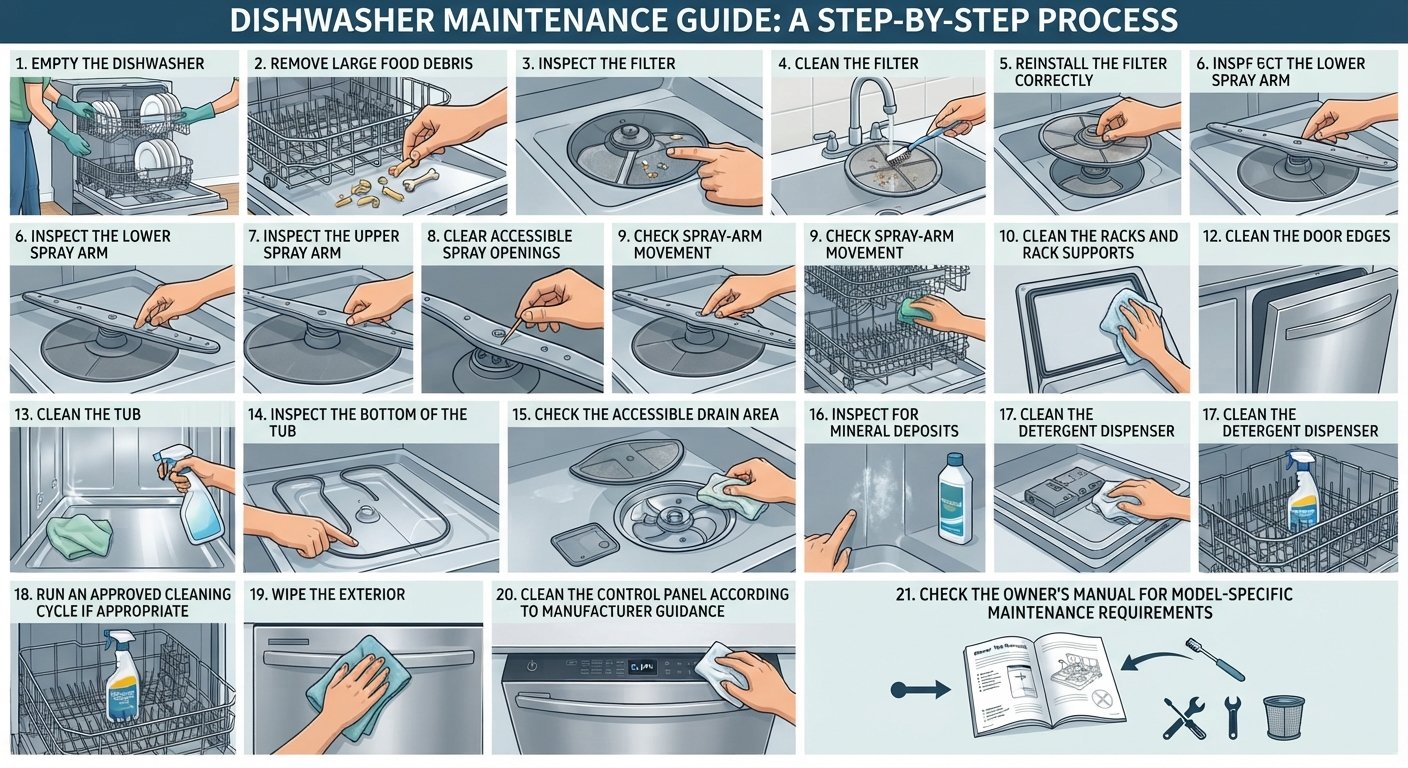
Dishwasher Cleaning Checklist
Use this checklist for a deeper dishwasher cleaning:
- Empty the dishwasher.
- Remove large food debris.
- Inspect the filter.
- Clean the filter.
- Reinstall the filter correctly.
- Inspect the lower spray arm.
- Inspect the upper spray arm.
- Clear accessible spray openings.
- Check spray-arm movement.
- Clean the racks and rack supports.
- Wipe the door gasket.
- Clean the door edges.
- Clean the tub.
- Inspect the bottom of the tub.
- Check the accessible drain area.
- Inspect for mineral deposits.
- Clean the detergent dispenser.
- Run an approved cleaning cycle if appropriate.
- Wipe the exterior.
- Clean the control panel according to manufacturer guidance.
- Check the owner's manual for model-specific maintenance requirements.
When Should You Call an Appliance Professional?
Routine cleaning is different from appliance repair.
Professional service may be appropriate when:
- The dishwasher repeatedly fails to drain after appropriate cleaning.
- Significant water consistently remains in the appliance.
- The dishwasher continues to clean poorly despite a clean filter and unobstructed spray arms.
- The appliance leaks.
- You suspect a failed pump, motor, valve, sensor, or other internal component.
- You notice electrical problems or damaged wiring.
- A component cannot be removed or reinstalled according to the manufacturer's instructions.
- A persistent odor remains despite thorough cleaning.
- The dishwasher repeatedly produces unusual operating symptoms.
- Manufacturer troubleshooting recommends professional service.
Cleaning removes debris, residue, grease, and buildup. Repair addresses a malfunctioning component or system.
Do not turn routine cleaning into an unnecessary attempt to dismantle internal appliance components.
Frequently Asked Questions
Where is the dishwasher filter?
On many dishwashers, the filter is located near the bottom of the tub, around or beneath the lower spray arm. The exact design and removal procedure vary by manufacturer and model. Check the owner's manual before removing it spray arms for food or mineral buildup, check their openings, rinse them, and use a soft brush to remove accessible debris. Remove them.
Does every dishwasher have a removable filter?
Dishwasher filtration systems vary. Some models have user-removable filters designed for routine cleaning, while others use different filtration arrangements. Do not force a component that does not release according to the manufacturer's instructions.
How often should I clean my dishwasher filter?
Follow your manufacturer's recommended maintenance schedule and inspect the filter regularly. Clean it whenever significant food debris or residue accumulates.
How do I clean dishwasher spray arms?
Inspect the spray arms for food or mineral buildup, check their openings, rinse them, and use a soft brush to remove accessible debris. Remove them only according to the manufacturer's instructions.
Why does my dishwasher spray arm need to rotate?
Spray-arm movement helps distribute water throughout the dishwasher. Blocked openings or an obstruction that prevents normal movement can interfere with water distribution.
Do I need to clean dishwasher racks?
Yes. Racks can collect food particles, detergent residue, grease, and mineral deposits. Inspect the rack surfaces, tines, wheels, and supports and clean visible buildup.
Can I put vinegar in my dishwasher?
Only when vinegar is compatible with your dishwasher manufacturer's instructions. Vinegar should not automatically be treated as a universal dishwasher cleaner.
Can I use baking soda in my dishwasher?
Baking soda may be suitable for some cleaning methods, but check the manufacturer's instructions before using it. Do not assume that a parts of the system, but water visibly pooling in the bottom of the tub after a completed cycle can indicate a drainage the spray arms, wipe the gasket, clean the racks and tub, check the accessible drain area and detergent dispenser, use only compatible cleaning products, and run a manufacturer-approved cleaning cycle when appropriate seal the door, the tub contains the wash water, the drain area helps remove wastewater, and the detergent dispenser releases dishwasher detergent, and the manufacturer's instructions for your specific dishwasher, respond to the buildup or household cleaning method is compatible with every dishwasher.
Can I use dish soap to clean a dishwasher?
Ordinary hand dishwashing liquid should not be used as an automatic dishwasher cleaning solution unless the manufacturer specifically instructs you to do so. It can create excessive suds.
Should I use a dishwasher cleaner?
A dishwasher cleaner may be appropriate for maintenance when recommended by the manufacturer. Follow the product instructions and confirm compatibility with your model.
Do I need to rinse dishes before loading them?
You generally do not need to fully wash or rinse dishes before loading them. However, remove large food particles and debris according to your dishwasher manufacturer's loading recommendations.
Why does my dishwasher smell bad?
Odors can result from food debris, grease, residue, or moisture accumulating in the filter, tub, drain area, gasket, spray arms, or detergent dispenser. Inspect and clean these areas first.
Why are my dishes still dirty after cleaning the dishwasher?
Check the filter, spray arms, loading arrangement, detergent use, and water distribution. If those areas are clean and the dishwasher still performs poorly, additional troubleshooting may be necessary.
Why does my dishwasher leave white residue?
White residue can come from mineral deposits, hard-water buildup, detergent residue, or other sources. Identify the type of buildup before selecting a cleaning or descaling method, and follow manufacturer guidance.
Do I need to clean the dishwasher drain?
Inspect and clean the accessible drain area according to your manufacturer's instructions. Do not dismantle internal drainage components as part of routine cleaning unless the manufacturer specifically instructs you to do so.
Is standing water in a dishwasher normal?
Some dishwasher designs may retain a small amount of water within parts of the system, but water visibly pooling in the bottom of the tub after a completed cycle can indicate a drainage problem. Check the accessible filter and drain area first and consult the manufacturer's troubleshooting guidance if the problem continues.
When should I stop cleaning and call a professional?
If cleaning does not resolve persistent drainage, leakage, poor cleaning performance, unusual operation, or other recurring problems, the issue may involve an internal component or system rather than routine buildup.
Need Cleaning Help in Chicago?
For Chicago households, routine cleaning and appliance maintenance can be part of keeping the home clean. Explore Deep Clean Chicago for more information.
Explore Deep Clean ChicagoFinal Takeaway
The most effective way to clean a dishwasher is to treat it as a group of connected components rather than simply an appliance that needs an occasional cleaning cycle.
Clean the filter, inspect the spray arms, wipe the gasket, clean the racks and tub, check the accessible drain area and detergent dispenser, use only compatible cleaning products, and run a manufacturer-approved cleaning cycle when appropriate.
Each component has a different role: the filter catches food debris, the spray arms distribute water, the gasket helps seal the door, the tub contains the wash water, the drain area helps remove wastewater, and the detergent dispenser releases dishwasher detergent.
For Chicago households—or any household—the same principle applies: follow the manufacturer's instructions for your specific dishwasher, respond to the buildup or symptoms you actually observe, and distinguish routine cleaning from problems that require appliance troubleshooting or repair.
The owner's manual remains the final authority because filter designs, component removal procedures, materials, cleaning products, and maintenance requirements differ between dishwasher models.