
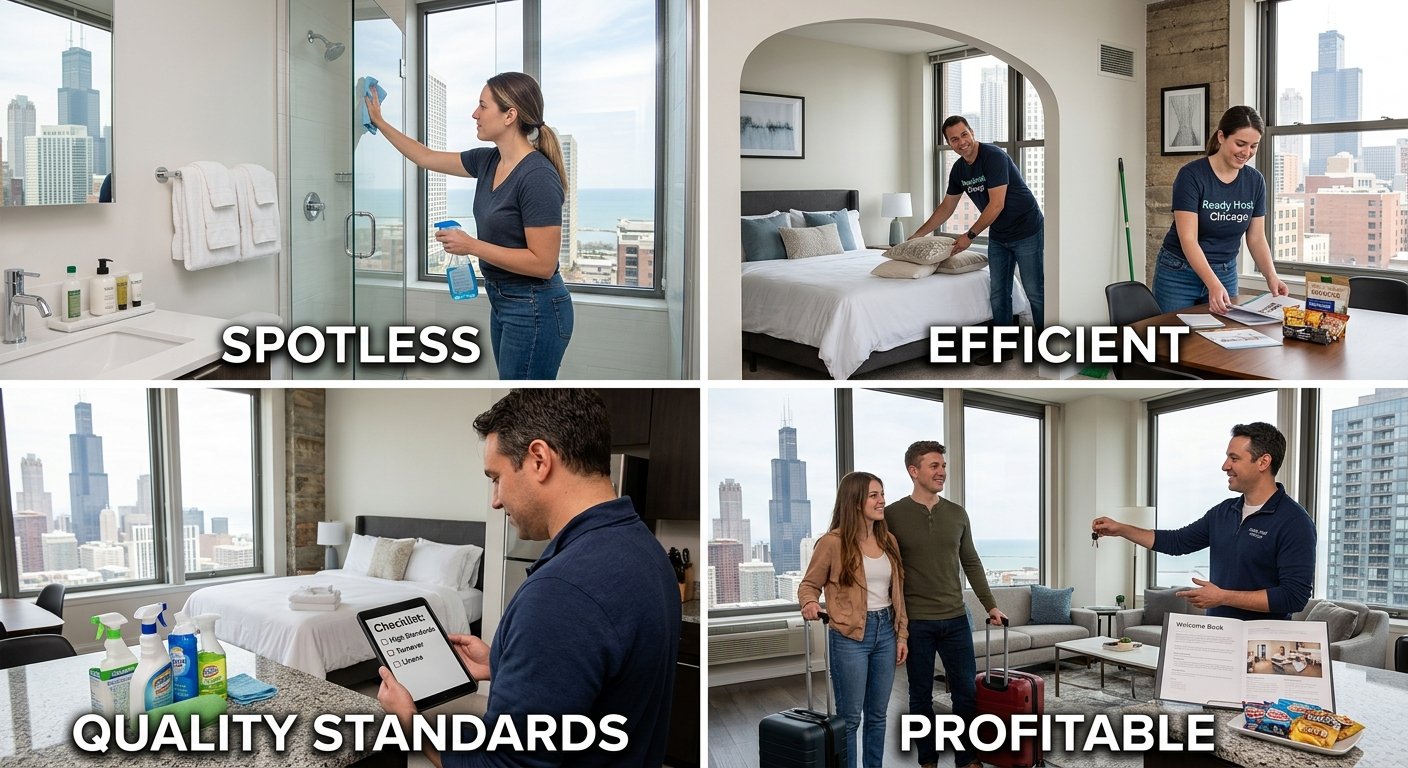
For a Chicago Airbnb host, cleaning is not just another operating expense. It sits directly between checkout and the next guest's first impression.
A cleaner who arrives late can put check-in at risk. A missed hair in the bathroom can become a poor review. A shortage of clean linens can turn a three-hour turnover into a crisis. And a cleaning fee that is too high can affect the total price guests see when comparing listings.
The real challenge is therefore not:
“How do I clean my Airbnb?”
It is:
“How do I build a turnover system that produces the same guest-ready result, every time, within the available window, without destroying my margins?”
For Chicago hosts, the answer is a system built around four outcomes:
Clean → Consistent → On time → Profitable
Airbnb requires listings to be clean and free of health hazards before check-in and expects hosts to clean between every stay. Airbnb also identifies cleanliness as one of the major factors associated with guest satisfaction and reviews.
The Four-Part Airbnb Turnover Problem
A host can have a cleaning problem even when the property is technically being cleaned.
There are four different failure points:
| Host objective | What can go wrong |
|---|---|
| Clean | Hair, dust, stains, odors, dirty dishes, missed surfaces |
| Consistent | Different cleaners produce different results |
| On time | Cleaner cancellation, laundry delays, access problems, tight turnovers |
| Profitable | Labor, laundry, supplies, emergency cleaning, and cleaning fees reduce margins |
The mistake is treating these as four separate problems.
They are connected.
Insufficient linen inventory → laundry delay → cleaner runs out of time → rushed inspection → missed cleaning detail → guest complaint → lower review → weaker listing performance.
A good host therefore manages the system, not just the cleaning task.
1. Start With the Core Standard: What Does “Guest-Ready” Mean?
The first question every host should answer is:
If a guest walked through the front door right now, what would need to be true for the property to be considered completely ready?
“Clean” is too vague.
Instead, define a measurable guest-ready standard.
A Chicago Airbnb should generally be ready with:
- Fresh, stain-free linens
- Clean bathrooms
- Clean kitchen and dishes
- Clean floors
- Dust-free visible surfaces
- Empty trash
- No leftover food
- Adequate guest supplies
- No obvious hair or debris
- Fresh-smelling rooms
- Furniture and décor reset
- Obvious damage identified
- Maintenance problems reported
Airbnb's own cleaning checklist includes clean surfaces and floors, fresh linens and towels, cleaned bathrooms, replenished soap, clean dishes and cookware, clean appliances, removed trash, and a fresh-smelling space.
The important point is that cleaning is only one part of guest readiness.
The property also has to be:
Clean + stocked + staged + inspected.
2. Build One Repeatable Airbnb Cleaning Checklist
One of the simplest ways to make cleaning more consistent is to stop relying on memory.
Airbnb recommends using a turnover checklist and following the same routine before each check-in.
A strong Chicago Airbnb checklist should be property-specific.
Before Cleaning
- Check for guest belongings
- Look for visible damage
- Check unusual odors
- Strip beds
- Collect used towels
- Start laundry
- Remove trash
- Check refrigerator for leftover food
Bedroom
- Replace sheets and pillowcases
- Check mattress/protective cover
- Make and inspect the bed
- Dust furniture
- Clean mirrors
- Check lamps and switches
- Vacuum or sweep floors
- Check underneath furniture
- Reset pillows and décor
Bathroom
- Clean and disinfect toilet
- Clean sink and faucet
- Clean shower/tub
- Remove hair
- Clean mirrors
- Wipe fixtures
- Mop floor
- Replace towels
- Refill soap and toiletries
- Empty trash
Kitchen
- Wash or put away dishes
- Clean sink
- Wipe countertops
- Clean cooktop
- Clean microwave
- Check refrigerator
- Wipe appliance surfaces
- Check cookware and utensils
- Restock supplies
- Remove trash
Living Areas
- Dust surfaces
- Clean visible glass
- Vacuum upholstery when needed
- Vacuum/sweep floors
- Mop hard floors
- Reset furniture
- Check remotes
- Reset décor
Final Inspection
- No visible hair
- No obvious stains
- No leftover food
- No trash
- Fresh linens
- Supplies stocked
- Property layout reset
- Damage reported
- Maintenance issues reported
- Access points secured
- Property matches the expected listing presentation
3. Solve the Laundry Problem Before It Becomes a Cleaning Problem
For many Airbnb hosts, laundry is the hidden bottleneck.
The cleaner may be capable of cleaning a property in two hours, but the operation can still fail because:
- Sheets are still in the washer
- Towels are in the dryer
- A duvet needs another cycle
- There are not enough spare linens
- A stain requires additional treatment
- The washer or dryer is occupied
Airbnb currently recommends keeping an extra set of bedding and towels available to make turnovers easier. and planning regular deep cleaning.
The cleaner should never depend on today's laundry being finished to make tomorrow's guest-ready bed.
For properties with frequent turnovers, consider maintaining at least one complete backup linen set for each bed.
For larger properties or aggressive back-to-back scheduling, more inventory may be appropriate.
The exact number depends on:
- Number of beds
- Number of bathrooms
- Booking frequency
- Laundry capacity
- Cleaner workflow
- Whether laundry is done on-site or off-site
The objective is operational resilience, not a universal linen number.
4. Treat the Turnover Window as a Production Schedule
Suppose:
Checkout = 11:00 AM
Check-in = 3:00 PM
It is tempting to call this a four-hour cleaning window.
It isn't.
For example, time can disappear through:
- Waiting for building access
- Parking
- Elevator delays
- Moving supplies
- Starting laundry
- Folding linens
- Restocking
- Reporting damage
- Taking photos
- Final inspection
This is especially important for Chicago properties in buildings where access, parking, elevators, concierge procedures, or loading restrictions can affect the actual workflow.
The key principle
Never schedule a turnover based only on the time required to clean an empty apartment.
Schedule it based on the time required to deliver a verified guest-ready property.
5. Don't Make the Cleaner Responsible for Everything
A common operational mistake is giving one person an enormous list of responsibilities:
Clean the apartment, do all laundry, restock everything, inspect damage, report maintenance, stage the property, and finish before the next guest arrives.
Sometimes this works.
Sometimes it doesn't.
A better system separates the responsibilities clearly.
Cleaner
- Cleaning
- Linen turnover
- Basic restocking
- Staging
- Visual inspection
- Reporting obvious problems
Host or property manager
- Inventory purchasing
- Scheduling
- Maintenance coordination
- Guest communication
- Damage documentation
- Pricing
- Backup planning
Backup support
- Emergency turnovers
- Cleaner absences
- Supply delivery
- Laundry overflow
- Maintenance emergencies
Clear responsibility prevents the classic:
“I thought someone else was handling that.”
6. Have a Backup Plan for Cleaner Cancellations
One of the most dangerous Airbnb cleaning problems is not a dirty property.
It is no cleaner at all.
Airbnb itself recommends having a second cleaner or another backup plan if the primary cleaner cannot make a scheduled turnover.
A serious host should know before an emergency:
- Who the backup cleaner is
- Where cleaning supplies are located
- Where spare linens are stored
- How the cleaner accesses the property
- Who can handle laundry
- Who can report maintenance issues
- Who can perform the final inspection
The backup person does not necessarily need to be a full-time second cleaner.
But there should be someone capable of responding when Plan A fails.
7. Make “Clean” Measurable
This is where many host-cleaner relationships break down.
The host says:
“The place wasn't clean.”
The cleaner says:
“I cleaned everything.”
Both may genuinely believe they are correct.
The problem is that “clean” has not been defined.
Instead of vague instructions, define observable standards.
Bathroom standard
No visible hair, water spots, toothpaste residue, dirty fixtures, or used guest items.
Bedroom standard
Fresh linens, properly made bed, no visible dust or debris, clear surfaces, and correct room setup.
Kitchen standard
Clean sink, clean dishes, clean cooking surfaces, no leftover food, empty trash, and stocked essentials.
Now the conversation becomes objective.
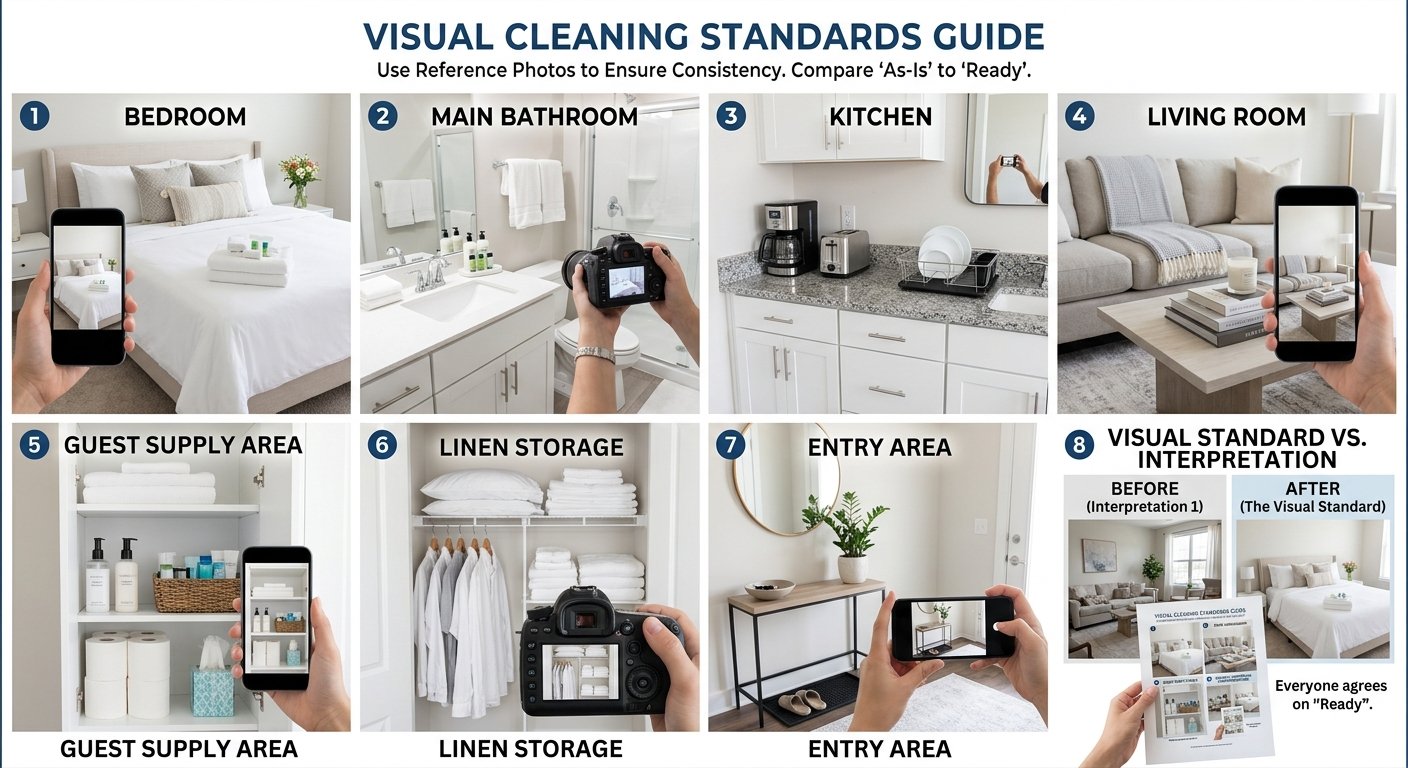
8. Use Photos to Create a Visual Standard
Written instructions are useful.
Photographs can be even better.
Take reference photos showing the desired final state of:
- Each bedroom
- Main bathroom
- Kitchen
- Living room
- Guest-supply area
- Linen storage
- Entry area
The cleaner can compare the finished property against the reference.
This solves a subtle but important problem:
Different people interpret “ready” differently.
A photo creates a shared standard.
It also becomes useful when you add a second cleaner.
9. Create a Two-Level Cleaning System
Not every cleaning task belongs in every turnover.
Trying to deep-clean the property after every guest can make your operation unnecessarily expensive.
Instead, separate:
Standard turnover
- Bathrooms
- Kitchen
- Floors
- Surfaces
- Linens
- Towels
- Trash
- Restocking
- Final inspection
Deep cleaning
- Baseboards
- Detailed grout cleaning
- Interior appliances
- Hard-to-reach areas
- Under heavy furniture
- Detailed blinds
- Wall spot cleaning
- Upholstery
- Other accumulated buildup
Airbnb currently recommends scheduling regular deep cleaning so ordinary turnovers remain easier to manage.
Turnover cleaning maintains guest readiness. Deep cleaning resets the property at a deeper level.
10. Diagnose Guest Complaints Instead of Simply Cleaning More
Suppose three guests mention:
“There was hair in the bathroom.”
The wrong response is:
“Tell the cleaner to clean harder.”
The better response is:
“Where does the process allow hair to remain?”
Possible causes include:
- Cleaner does not inspect the floor after mopping
- Hair collects around the drain
- Bathroom is cleaned before other work creates additional debris
- Final inspection is skipped
- Cleaner is rushing
- No visual bathroom checklist exists
The solution should target the cause.
Repeated complaints are process data.
Track them.
If complaints repeatedly concern the same area, modify the workflow rather than simply increasing cleaning effort.
11. Solve the “Looks Clean but Doesn't Feel Clean” Problem
Guests don't evaluate cleanliness with laboratory equipment.
They evaluate it visually and emotionally.
A property can technically be clean while still looking neglected.
Examples include:
- Streaked mirrors
- Fingerprints on appliances
- Crooked bedding
- Cluttered counters
- Mismatched towels
- Dust on visible surfaces
- Poorly arranged furniture
- Empty dispensers
- Overfilled trash
- Strong artificial fragrance
This is why presentation is part of cleanliness perception.
The final five-minute inspection can therefore be disproportionately valuable.
Stand at the front door and ask:
What would a guest notice first?
Then inspect those things.
12. Make Restocking Part of the Turnover System
A cleaner shouldn't discover that you're out of toilet paper when the next guest is arriving.
Maintain minimum inventory levels for:
- Toilet paper
- Paper towels
- Hand soap
- Dish soap
- Dishwasher detergent
- Trash bags
- Sponges
- Laundry supplies
- Guest toiletries, if provided
- Linens
- Towels
Airbnb's current hosting guidance recommends recurring orders for common cleaning products and essentials to reduce supply shortages.
When inventory reaches the minimum level, reorder.
This turns restocking from an emergency into a routine.
13. Protect Profitability by Knowing Your True Turnover Cost
A host should not calculate profitability using only the cleaner's invoice.
The actual turnover cost can include:
Cleaner labor + laundry + cleaning products + guest supplies + linen replacement + emergency cleaning + travel/access costs + deep cleaning allocation + management time
That is your true turnover cost.
For example, imagine a host pays:
- $110 cleaning labor
- $20 laundry
- $12 supplies
- $8 consumables
- $10 average deep-clean allocation
The operational turnover cost is already:
$160
That's more meaningful than simply saying:
“My cleaner charges $110.”
14. Don't Automatically Increase the Cleaning Fee
A higher cleaning fee can recover more of the host's cost.
But it also increases the guest's total booking price.
Airbnb's current guidance explicitly warns that an excessively high cleaning fee can discourage bookings, while noting that cleanliness is a major factor in guest satisfaction.
This creates a balancing act:
The objective isn't necessarily to maximize the cleaning fee.
It's to build a cleaning operation whose total cost makes sense for the property's pricing and occupancy strategy.
Airbnb also says cleaning fees are intended to cover expected housekeeping rather than function as an additional profit source.
15. Don't Underpay for the Sake of Saving Money
A host may try to reduce cleaning costs by finding the cheapest available cleaner.
That can backfire.
A cleaner who is consistently rushed, underpaid, or given an unrealistic workload may have difficulty maintaining the required standard.
Airbnb's U.S. Living Wage Pledge guidance encourages hosts to consider fair compensation, clear expectations, and health and safety standards for cleaners.
The better question isn't:
“What's the cheapest cleaner I can find?”
It's:
“What's the lowest sustainable cost for reliably producing my required guest-ready standard?”
Those are very different questions.
16. Build a Cleaner Scorecard
For hosts managing multiple turnovers, intuition isn't enough.
Track a few practical metrics.
| Metric | What it tells you |
|---|---|
| On-time completion | Reliability |
| Guest cleanliness complaints | Quality |
| Re-clean requests | Consistency |
| Missing supplies | Inventory control |
| Damage missed | Inspection quality |
| Turnover duration | Scheduling efficiency |
| Emergency call-outs | System resilience |
| Cost per turnover | Profitability |
You don't need a complicated software platform.
A spreadsheet can be enough.
The goal is to identify patterns.
17. Use a Five-Step Turnover Framework
1. Clean
Remove dirt, dust, debris, stains, and visible contamination.
2. Reset
Return beds, furniture, décor, towels, and rooms to the expected presentation.
3. Restock
Replace supplies and consumables.
4. Inspect
Look for cleanliness problems, damage, missing items, odors, and maintenance issues.
5. Confirm
Verify that the property is genuinely ready for the next guest.
This distinction matters.
A cleaner can finish cleaning without finishing the turnover.
The turnover is complete only when the property is ready to host.
18. What Chicago Airbnb Hosts Should Do When a Turnover Goes Wrong
When something goes wrong, don't immediately blame the cleaner.
Diagnose the failure.
If the cleaner is late
Ask:
- Was the turnover window realistic?
- Was building access delayed?
- Was laundry the bottleneck?
- Was the property unusually dirty?
- Did the cleaner have another job immediately before it?
If the property isn't clean enough
Ask:
- What specifically was missed?
- Was it on the checklist?
- Was there a final inspection?
- Is the problem recurring?
- Does the cleaner have enough time?
If cleaning costs are too high
Ask:
- Is the property taking longer than expected?
- Are deep-clean tasks being included in every turnover?
- Is laundry inefficient?
- Are supplies being wasted?
- Is the cleaning scope clearly defined?
If guests keep complaining
Look for patterns rather than isolated incidents.
The goal is not merely to solve today's problem.
It is to prevent the same problem on the next turnover.
19. A Practical Chicago Airbnb Turnover Workflow
Checkout
Guest leaves.
↓
Initial inspection
Cleaner checks for belongings, damage, unusual mess, and odors.
↓
Laundry begins
Beds and towels are stripped and laundry starts immediately.
↓
Cleaning
Bathrooms → kitchen → bedrooms → living areas → detailed surfaces.
↓
Restocking
Supplies and guest essentials are replenished.
↓
Floors
Vacuuming/sweeping and mopping are completed after other cleaning generates debris.
↓
Reset
Furniture, beds, towels, décor, and supplies return to their standard positions.
↓
Final inspection
Cleaner or host checks the property against the checklist.
↓
Problem report
Damage, missing supplies, maintenance issues, or unusual cleaning requirements are documented.
↓
Guest-ready confirmation
The property is ready for check-in.
This workflow reduces the risk of discovering an important problem five minutes before the guest arrives.
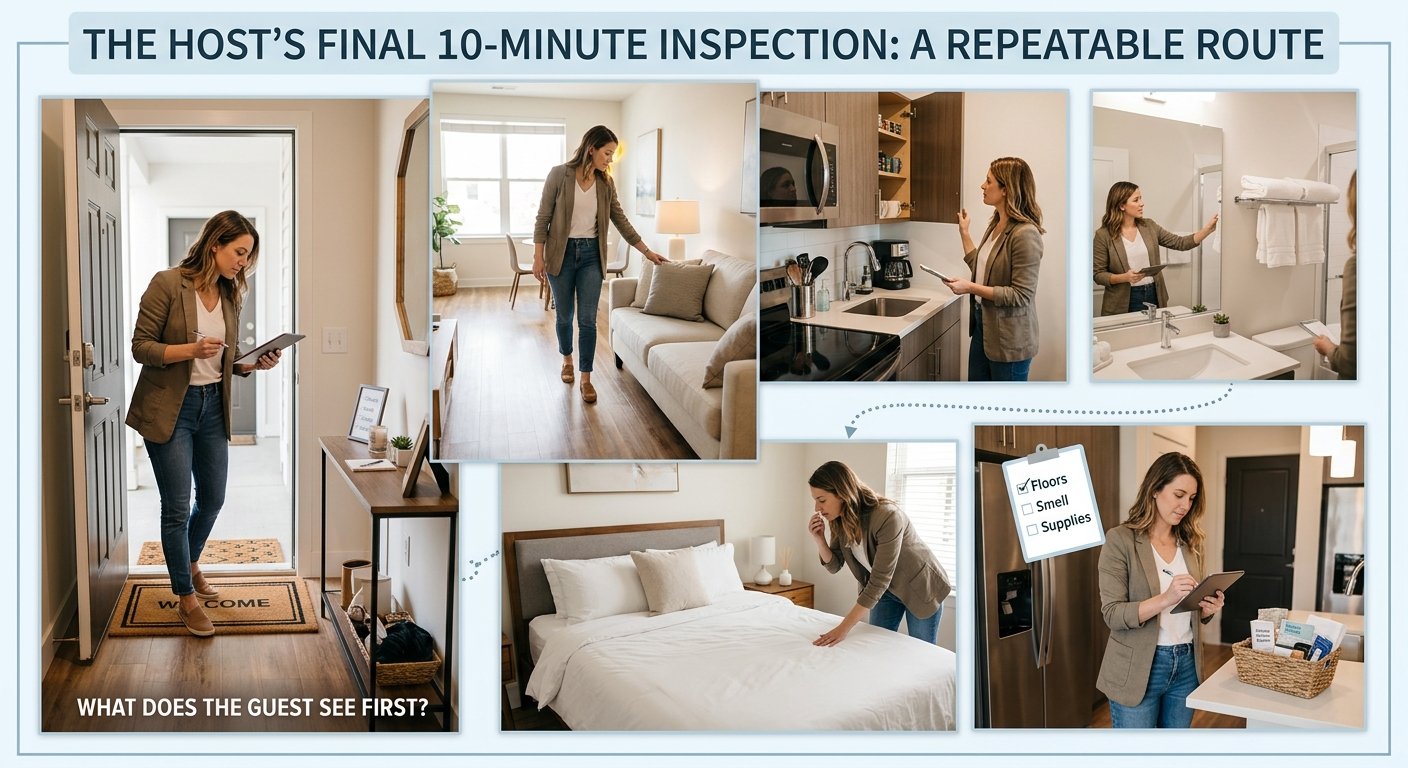
20. The Host's Final 10-Minute Inspection
Even if a professional cleaner handles the turnover, a host or manager should consider periodic quality-control inspections.
The fastest inspection starts at the entrance.
Ask:
What does the guest see first?
Then check:
- Entry
- Living room
- Kitchen
- Bathroom
- Bedroom
- Floors
- Smell
- Supplies
Don't spend ten minutes randomly looking around.
Use a repeatable route.
Consistency in inspection creates consistency in cleaning.
21. The Most Important Shift: Stop Managing Cleaning as a Task
A host who manages cleaning as a task asks:
“Did the cleaner clean today?”
A host who manages cleaning as a system asks:
“Did the property reliably move from checkout condition to guest-ready condition within the required time and cost?”
That second question is much more useful.
It captures:
- Quality
- Timing
- Labor
- Laundry
- Inventory
- Maintenance
- Guest experience
- Profitability
And it changes how you solve problems.
Airbnb Cleaning Problems: Quick Diagnostic Guide
| Problem | Likely cause | Better solution |
|---|---|---|
| Cleaner finishes late | Unrealistic schedule or laundry bottleneck | Measure actual turnover time |
| Guest finds hair | Weak inspection process | Add visual final inspection |
| Linens aren't ready | Insufficient inventory | Add backup linen sets |
| Cleaner cancellation | No redundancy | Maintain backup cleaner |
| Cleaning cost too high | Scope or workflow inefficiency | Separate turnover from deep cleaning |
| Guests complain despite cleaning | Presentation gap | Define guest-ready standard |
| Supplies run out | No inventory threshold | Establish minimum stock levels |
| Different cleaners produce different results | No standardized process | Checklist + reference photos |
| Damage is discovered too late | No inspection/reporting process | Add turnover condition check |
| Cleaning fee hurts bookings | Total price too high | Review total cost and competitive pricing |
The Bottom Line
For Chicago Airbnb hosts, profitable cleaning isn't about finding the cheapest cleaner or creating the longest checklist.
It's about building a repeatable turnover system.
The system should make five things predictable:
- The property is clean.
- The property looks consistent.
- The turnover finishes before check-in.
- Problems are discovered before guests do.
- The cost makes financial sense.
Airbnb's current guidance supports the same basic principles: clean between every stay, use a consistent cleaning routine, keep backup supplies and linens, schedule regular deep cleaning, and maintain a backup plan for turnover problems.
For a Chicago host, the ultimate KPI isn't simply “cleaning completed.”
Guest-ready, on time, every turnover, at a sustainable cost.
That's the standard that turns Airbnb cleaning from a recurring headache into a manageable operating system.
Need Airbnb Cleaning in Chicago?
Keep your Airbnb turnover clean, consistent, and ready for the next guest with professional Airbnb cleaning in Chicago.
Learn More About Airbnb Cleaning